
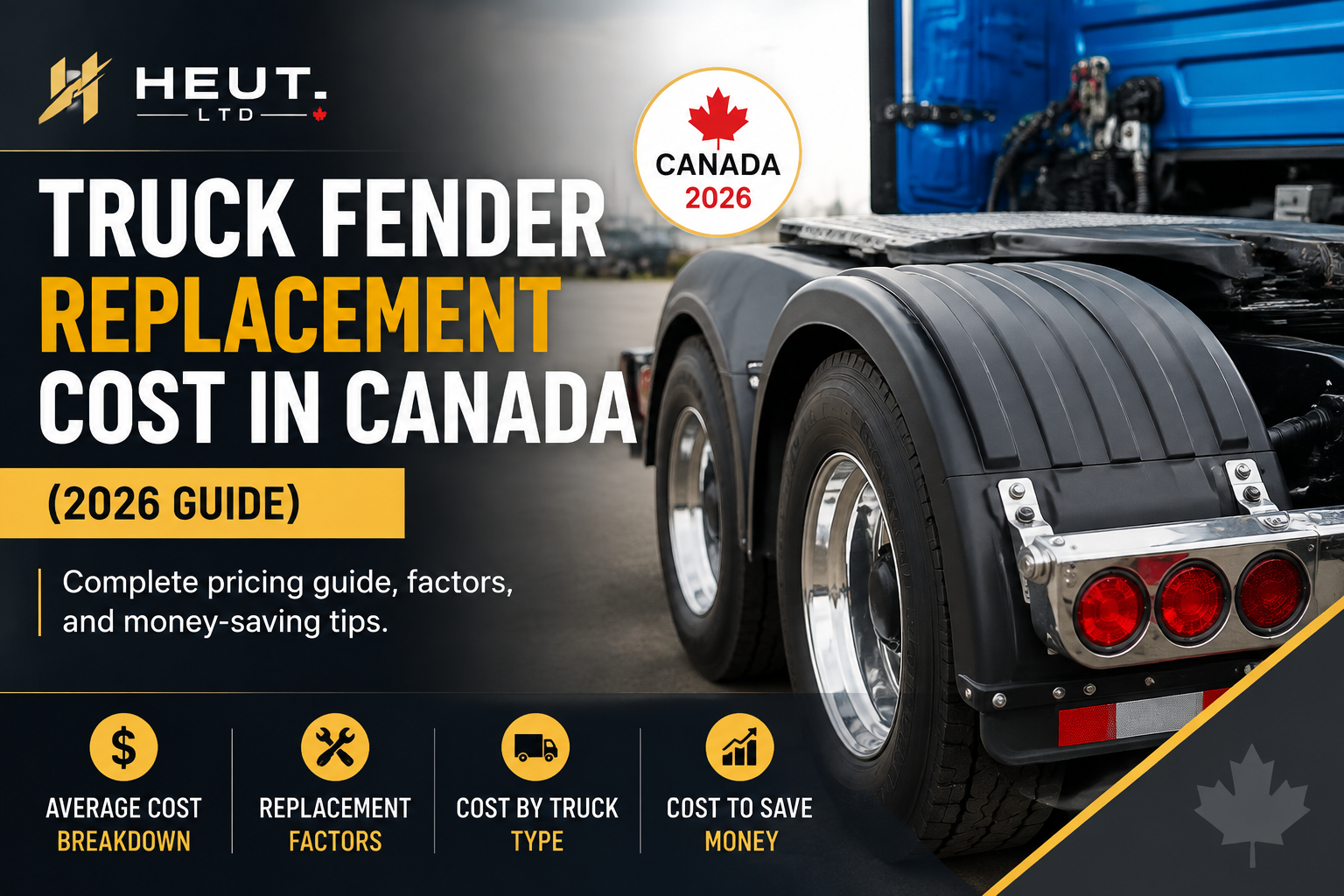
Real 2026 pricing for poly, aluminum and stainless fenders — plus the hidden cost most owner-operators don’t budget for.
| QUICK ANSWER In Canada in 2026, replacing a set of heavy truck fenders typically runs $200 to $600 for poly, $300 to $800 for aluminum, and $450 to $1,300 for stainless steel, plus roughly $80 to $250 for a mounting hardware kit. Shop labour adds one to three hours at $95 to $160 per hour, though most fender swaps are a straightforward bolt-on job an owner-operator can do in a driveway. The bigger cost is buying twice — steel fenders rust out in salt country, and fibreglass cracks in cold, which is why poly with a lifetime warranty usually wins over a truck’s service life. |
You already know exactly which fender it is. It caught a chunk of ice off the trailer somewhere outside Thunder Bay, and now there’s a crack running up from the bracket that gets a little longer every week. It rattles on washboard. It throws spray straight up the side of the cab.
So you go looking for a price, and you get numbers all over the map — $89 on one site, $700 on another, and no explanation for the gap. Here’s what actually drives that difference, what you should expect to pay in Canada in 2026, and how to make sure you’re not buying the same part again in two winters.
How much does truck fender replacement cost in Canada?
For heavy trucks, the part itself is the main line item. Here’s what the Canadian market looks like heading through 2026:
| What You’re Buying | Poly | Aluminum | Stainless Steel |
| Half fenders (pair) | $150 – $350 | $220 – $500 | $350 – $850 |
| Full / tandem fenders (pair) | $250 – $600 | $350 – $800 | $550 – $1,300 |
| Quarter fenders (pair) | $120 – $300 | $180 – $420 | $280 – $700 |
| Single replacement fender | $85 – $320 | $130 – $430 | $200 – $680 |
| Mounting hardware kit | $80 – $250 | $90 – $260 | $110 – $300 |
| Shop install labour | 1 – 3 hrs @ $95 – $160/hr | 1 – 3 hrs | 2 – 4 hrs |
Ranges are directional market estimates for planning. Confirm current pricing against the product pages before you order.
Most owner-operators land somewhere between $300 and $800 all-in for a pair of fenders with hardware, doing the install themselves. Take it to a shop and add another $150 to $450 in labour depending on how seized the old mounting bolts are.
What actually moves the price up or down?
Four things explain almost every price gap you’ll see:
- Material — poly, aluminum, stainless and fibreglass sit at genuinely different price points, and they are not interchangeable in how long they last. More on that below.
- Coverage and size — quarter fenders cost less than half fenders, which cost less than full tandem sets. Make sure you’re comparing the same configuration before you compare prices.
- Whether hardware is included — a bare fender with no brackets is cheaper on the listing and more expensive by the time you’ve sourced offset pipes, brackets and fasteners separately. Kits that include mounting hardware are usually the better number.
- Where it ships from — cross-border orders pick up freight, duty and exchange. A Canadian-manufactured fender shipping domestically usually lands cheaper than a cheaper American part once it clears the border.
That last point catches a lot of buyers. A listing that looks $60 cheaper can arrive $140 more expensive.
| Priced it out? See the Canadian-made option. Heut LTD manufactures medium-density poly truck fenders, mounting hardware kits and accessories right here in Cooks Creek, Manitoba — shipping domestically, backed by a limited lifetime warranty. Browse fenders and kits at heut.ca |
Poly, aluminum, stainless or fibreglass — which lasts in Canada?
This is the decision that determines whether you’re reading this article again in three years.
| Material | How It Handles Canadian Roads | Typical Failure Mode | Service Life |
| Poly (MDPE) | Flexes on impact and returns to shape; unaffected by road salt | Surface scuffing over many years | 10+ years |
| Aluminum | Light and rust-resistant, but dents permanently and can fatigue at mounts | Dents, cracked mounting points | 5 – 10 years |
| Stainless steel | Looks sharp and holds shape, but heavy and vulnerable at welds and edges | Corrosion at seams, bending | 5 – 12 years |
| Painted / mild steel | Rusts fast once the coating is chipped by gravel | Rust-through | 2 – 5 years |
| Fibreglass | Rigid and prone to cracking, especially in deep cold | Cracks, shatters on impact | 3 – 6 years |
Canadian conditions punish two things in particular: road salt and cold-weather impact. Salt attacks steel at every weld, seam and chip in the coating — and once rust starts under a chip, the fender is on a countdown. Cold makes rigid materials brittle, which is why fibreglass that survives a summer of gravel will crack from a single frozen slush chunk in February.
Medium-density polyethylene sidesteps both. It doesn’t corrode because there’s nothing in it to oxidise, and it flexes on impact rather than dents or shatters — it takes the hit and returns to shape. It’s also significantly lighter, which matters if you’re running close to your weight allowance.
The trade-off is honest: poly won’t give you the mirror-polish look of stainless. If your truck is a show piece, stainless has an appeal poly can’t match. If your truck is a working asset, poly is the lower-cost decision over its service life.
Should you replace one fender or the whole set?
If the damaged fender is under about three years old and the other side is in good shape, replacing the single fender is reasonable. Beyond that, most operators are better off doing the pair.
The reason is practical rather than cosmetic. Fenders age together — same salt, same gravel, same UV. When one fails at year six, the other is usually a season or two behind it. Doing both at once means one order, one round of shipping, one afternoon of work, and a matched appearance instead of a new fender bolted next to a faded one.
| BUDGET TIP Order the mounting hardware kit with the fenders even if your existing brackets look serviceable. Old bolts seize, and a $90 kit is far cheaper than an afternoon lost to snapping rusted fasteners and hunting for replacements. |
Can you install truck fenders yourself?
For most owner-operators, yes. A standard fender swap is a bolt-on job requiring basic hand tools, a jack or a level surface, and one to two hours per side. Poly fenders in particular are light enough to handle solo.
The sequence is straightforward: support the truck safely, unbolt the old fender from its brackets, inspect the brackets and offset pipes for rust or bending, install the new mounting hardware, hang the fender, and set your clearances before final torque.
Take it to a shop if the mounting brackets themselves are damaged or heavily corroded, if you’re changing fender style and need new mounting geometry, or if the truck is under a fleet maintenance agreement that requires documented work.
The cost most operators forget to budget
The part price is the easy number. Three others are bigger:
- Compliance risk — a fender in poor condition can draw attention during an inspection, and splash-guard and spray-suppression requirements vary by province. A cracked or missing fender is an avoidable flag on a roadside inspection.
- Downtime — a day off the road for an unplanned repair costs most owner-operators more than the entire set of fenders. Replacing a cracked fender on your schedule is far cheaper than replacing a failed one on someone else’s.
- What the spray hits — that’s the whole job of a fender. Spray goes onto your own trailer, into the airflow behind you, and onto the vehicle sharing the lane. It also means salt spray coating components you’d rather it didn’t reach.
Run the arithmetic over a truck’s service life and the picture is clear. A $250 poly set that lasts ten years costs less than three $180 steel sets that rust out — before you count the labour and downtime for each replacement.
How to buy so you’re not doing this again
Four things to check before you order:
- Warranty length — a limited lifetime warranty tells you the manufacturer expects the part to outlast your ownership. A 90-day warranty tells you something too.
- Fit to your configuration — confirm the fender is specified for your axle configuration and tire size. Coverage that’s slightly short throws spray no matter how good the part is.
- Where it’s made and shipped from — domestic manufacturing means no border delays on a replacement, and support in your time zone.
- Whether hardware is engineered to match — a manufacturer that sells matched mounting kits has already solved the fit problem you’d otherwise solve yourself in a parts aisle.
Frequently asked questions
How much does it cost to replace a truck fender in Canada?
Expect $150 to $350 for a pair of poly half fenders, $250 to $600 for full tandem sets, and $350 to $1,300 for aluminum or stainless equivalents. Add $80 to $250 for a mounting hardware kit. Shop installation adds one to three hours at roughly $95 to $160 per hour, though most swaps are a DIY job.
Are poly truck fenders better than steel?
For Canadian conditions, generally yes. Poly doesn’t corrode from road salt and flexes on impact instead of denting or rusting through, while steel fails at chips, welds and seams once salt gets in. Steel and stainless still win on polished appearance for show trucks.
How long do truck fenders last?
Quality poly fenders commonly last ten years or more. Aluminum and stainless typically run five to twelve years depending on salt exposure and impact damage. Painted mild steel often fails within two to five years in salt country, and fibreglass three to six years due to cold-weather cracking.
Can I install truck fenders myself?
Most owner-operators can. It’s a bolt-on job needing basic hand tools and one to two hours per side, and poly fenders are light enough to handle alone. Use a shop if the mounting brackets are damaged or badly corroded, or if you’re changing fender style and need different mounting geometry.
Do I need to replace both fenders at the same time?
Not necessarily, but it’s usually the better value. Fenders age together under the same salt, gravel and UV exposure, so when one fails the other is typically close behind. Doing the pair means one shipment, one install session, and a matched appearance.
Are truck fenders required by law in Canada?
Splash guard and spray suppression requirements are set provincially and vary across jurisdictions, so check the rules where you operate. As a practical matter, damaged or missing fenders invite scrutiny at roadside inspections — worth confirming your configuration with your provincial regulator.
| Built in Manitoba. Backed for life. Heut LTD poly truck fenders are manufactured at the Heartland Hutterite Colony in Cooks Creek, Manitoba, with matched mounting hardware kits and a limited lifetime warranty. Fleet and dealer pricing available. Shop now at heut.ca |