
Half, Full, or Quarter Fenders: Which Truck Fenders Do You Actually Need?
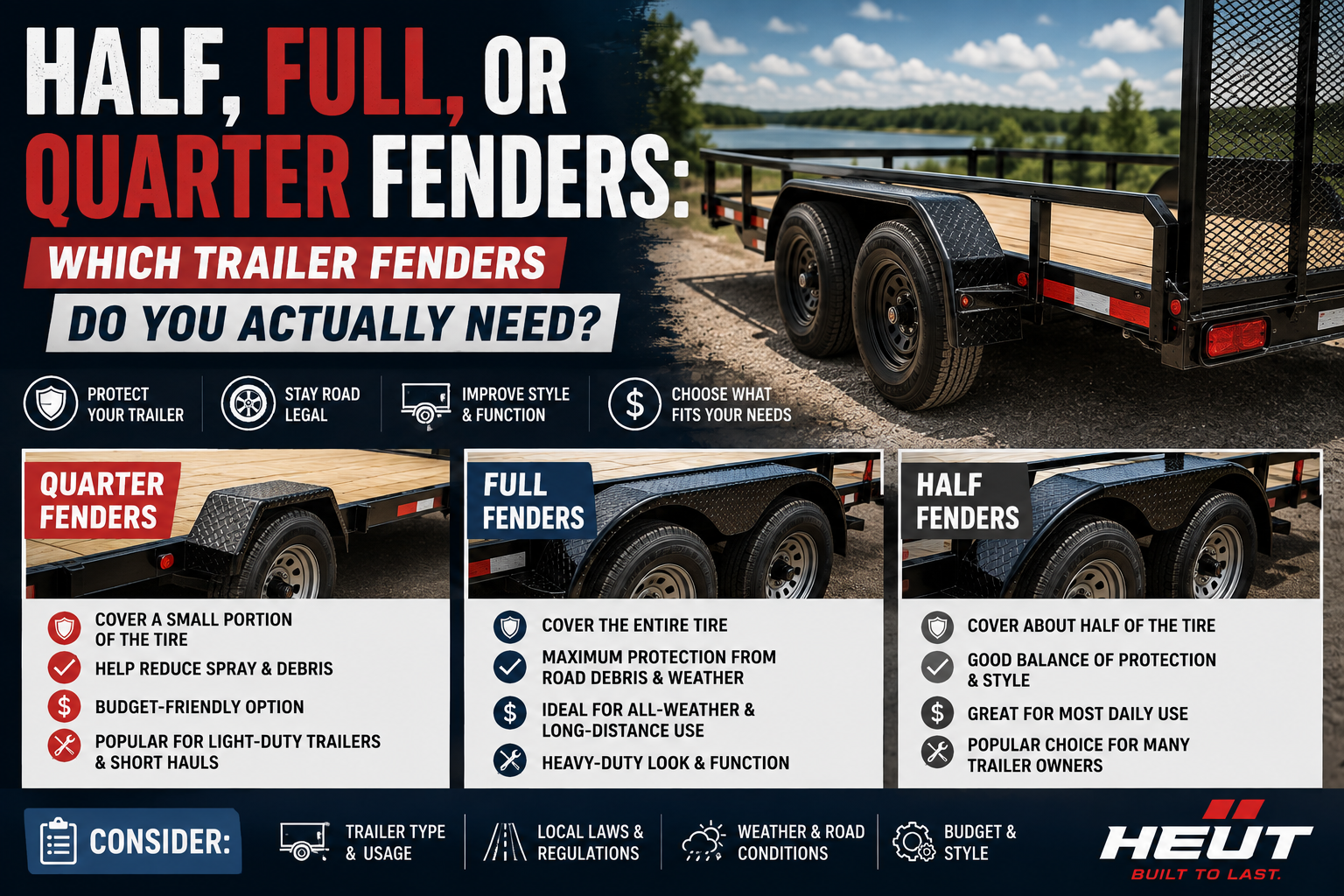
Table of Contents
A plain-English fit guide — what each style does, how to measure once, and the hardware nobody mentions until you’re already under the truck.
| QUICK ANSWER Half fenders cover the top arc of the tire and are the most common choice on tandem drives — good spray control with easy access for chains and tire work. Full or tandem fenders extend down both sides for maximum spray suppression, which matters most in wet and salted conditions. Quarter fenders are short, straight sections that mount behind the tire to catch throw-off, often used alongside another fender or on tight-clearance setups. Choose the style by how much spray control you need, then size it by your tire diameter and, for tandems, your axle spread — measure both before ordering. |
You know your truck. What you probably do not know is the vocabulary the catalogue uses — half, full, tandem, quarter, single-axle — and whether the set you are looking at will actually clear your tires when the suspension moves.
That uncertainty is why a lot of people put the order off, run another season on a cracked fender, and end up buying under pressure when it finally lets go on the highway.
This guide fixes that. Here is what each style does, how to work out which one suits your setup, and exactly what to measure so the set that arrives bolts on the first time.
What’s the difference between the fender styles?
Most of the confusion comes from the fact that the names describe coverage, not size. Here is the plain version:
| Style | What It Covers | Best For | Spray Control |
| Half fenders | The top arc of the tire, roughly from front to rear of the wheel | Tandem drives; operators who chain up or service tires often | Good |
| Full / tandem fenders | Top arc plus extended coverage down both sides | Wet climates, salted highways, spray-sensitive work | Best |
| Quarter fenders | A short straight section mounted behind the tire | Catching rear throw-off; tight-clearance setups | Targeted |
| Single-axle fenders | One wheel position rather than a tandem set | Single drive axles, trailers, straight trucks | Good |
| Poly vs metal | Same coverage — different behaviour on impact and salt | Poly flexes and won’t corrode; metal dents and rusts | Equal |
The trade-off between half and full fenders is coverage versus access. Full fenders throw the least spray, which matters through a Canadian winter when what is coming off your tires is not just water but brine. Half fenders give up some of that coverage in exchange for getting at your tires quickly — which matters a great deal if you chain up regularly or run somewhere tire work happens on the shoulder rather than in a shop.
Quarter fenders serve a different purpose. They are not a budget version of a full fender; they are a targeted solution for catching rear throw-off, and they fit setups where a full arc simply will not clear.
Which style suits your setup?
Match your configuration to the usual answer:
| Your Setup | Usual Choice | Why |
| Tandem drive, long haul, all seasons | Full / tandem fenders | Maximum spray suppression through wet and salted highway miles |
| Tandem drive, frequent chain-up | Half fenders | Easier access to tires and chains without fighting coverage |
| Single drive axle | Single-axle fenders | Sized to one wheel position rather than a spread |
| Tight frame or suspension clearance | Quarter fenders | Short profile fits where a full arc won’t clear |
| Show truck / appearance build | Full fenders | Cleanest continuous line, most finished look |
| Mixed fleet, standardising parts | One style across the fleet | Fewer part numbers, simpler stocking, faster roadside swaps |
If you run a mixed fleet, there is a case for standardising on one style even where a second style would technically suit a few trucks better. One part number means simpler stocking, faster roadside swaps, and no guessing which box on the shelf fits which unit.
How to measure so you only order once
This is where orders go wrong, and it takes about ten minutes to get right. Before you order, write down:
1. Your tire size — the full designation off the sidewall, such as 11R22.5 or 11R24.5. Fender radius is matched to tire diameter, and this is the single most important number.
2. Your axle configuration — single or tandem. If tandem, measure the axle spread centre to centre, because that determines whether a tandem fender will span correctly.
3. Available clearance — from the top of the tire to the frame or whatever sits above it. Then check it again with the suspension compressed, not just sitting level in the yard.
4. Your mounting situation — what the old fenders bolted to, and whether those brackets, offset pipes and fasteners are still sound. Photograph them before you take anything apart.
5. Width across the tires — particularly on duals, so the fender covers the full tread rather than most of it.
| THE MEASUREMENT PEOPLE FORGET Check your clearance with the suspension compressed, not at rest. A fender that clears beautifully in the yard can contact the tire under load on a rough road — and by the time you find that out, you have a rubbed fender and a wear mark on a tire you paid for. |
One more thing worth flagging: if you have changed tire size since the original fenders were fitted — going from 22.5 to 24.5, for example — do not order by matching the old part. Order by measuring what is on the truck now.
| Got your measurements? Let’s get the right set on your truck. Heut LTD manufactures medium-density poly truck fenders in half, full and quarter configurations, with matched mounting hardware kits — built in Cooks Creek, Manitoba and backed by a limited lifetime warranty. Browse fenders and kits at heut.ca |
The hardware question nobody asks until it’s too late
A fender is only as good as what holds it on, and this is where a cheap listing stops being cheap.
A bare fender with no brackets looks like a bargain on the product page. Then you discover you need offset pipes, brackets and fasteners that were not included, you are sourcing them from a second supplier, and the geometry does not quite line up because they were never designed to work together.
Buying a matched mounting kit with the fenders solves a problem you would otherwise solve yourself in a parts aisle, badly. It also matters structurally — mounting hardware carries the load and takes the vibration, and mismatched components are the most common reason a fender that should last a decade fails at the mount in year three.
Even where your existing brackets look serviceable, fresh hardware is worth it. Old bolts seize, and an afternoon lost to snapping rusted fasteners costs more than the kit.
Why material matters more in Canada than most places
Whichever style you land on, the material decides how long it lasts here.
Road salt attacks steel at every chip, weld and seam, and once rust starts under a stone chip the fender is on a countdown. Cold makes rigid materials brittle, which is why fibreglass that survives a summer of gravel can crack from a single frozen slush chunk in February.
Medium-density polyethylene sidesteps both. It does not corrode, because there is nothing in it to oxidise, and it flexes on impact rather than denting or shattering — it takes the hit and returns to shape. It is also lighter, which matters when you are running near your weight allowance.
The trade-off is honest: poly will not give you the mirror finish of polished stainless. If the truck is a show piece, that is a real consideration. If it is a working asset, poly is the cheaper decision measured over its service life.
Five ordering mistakes worth avoiding
- Ordering by eye instead of by tire size — fender radius is matched to tire diameter, and close enough is not close enough.
- Buying bare fenders to save on a kit — by the time you have sourced brackets separately, you have spent more and fitted worse.
- Matching the old fender after a tire change — if you went from 22.5 to 24.5, the old part number is now the wrong part number.
- Measuring clearance only at ride height — clearance that works at rest can fail under compression.
- Replacing one side only — fenders age together under the same salt and gravel. When one goes, the other is usually a season behind, and doing the pair means one shipment and one afternoon.
Frequently asked questions
What is the difference between half fenders and full fenders?
Half fenders cover the top arc of the tire, giving good spray control while leaving easy access for chains and tire work. Full or tandem fenders extend further down both sides for maximum spray suppression, which matters most on wet and salted highways. The trade-off is coverage versus access.
What are quarter fenders used for?
Quarter fenders are short, straight sections that mount behind the tire to catch rear throw-off. They are used where a full arc will not clear because of tight frame or suspension clearance, and often alongside another fender rather than as a replacement for one.
How do I know what size truck fenders I need?
Start with your tire size off the sidewall, such as 11R22.5 or 11R24.5, because fender radius is matched to tire diameter. Then note single or tandem axle configuration and, for tandems, the axle spread measured centre to centre. Finally check clearance above the tire with the suspension compressed rather than at rest.
Do truck fenders come with mounting hardware?
Not always — many listings show the fender alone, with brackets, offset pipes and fasteners sold separately. Buying a matched mounting kit is usually both cheaper overall and structurally better, since the hardware carries the load and mismatched components are a common cause of early failure at the mount.
Are poly truck fenders better than steel or aluminum?
For Canadian conditions, generally yes. Poly does not corrode from road salt and flexes on impact rather than denting or rusting through, while steel fails at chips, welds and seams once salt gets in. Polished stainless still wins on appearance for show trucks.
Can I use half fenders on a single axle truck?
You would normally use fenders sized for a single wheel position rather than a tandem set, since tandem fenders are dimensioned to span an axle spread you do not have. Measure your tire size and available clearance, and confirm the fender is specified for single-axle use before ordering.
| Built in Manitoba. Backed for life. Heut LTD poly truck fenders are manufactured at the Heartland Hutterite Colony in Cooks Creek, Manitoba, with matched mounting hardware and a limited lifetime warranty. Fleet and dealer pricing available. Order at heut.ca — or call for help sizing your set |