
Best Truck Fenders for Canadian Winters: Poly vs Steel vs Aluminum
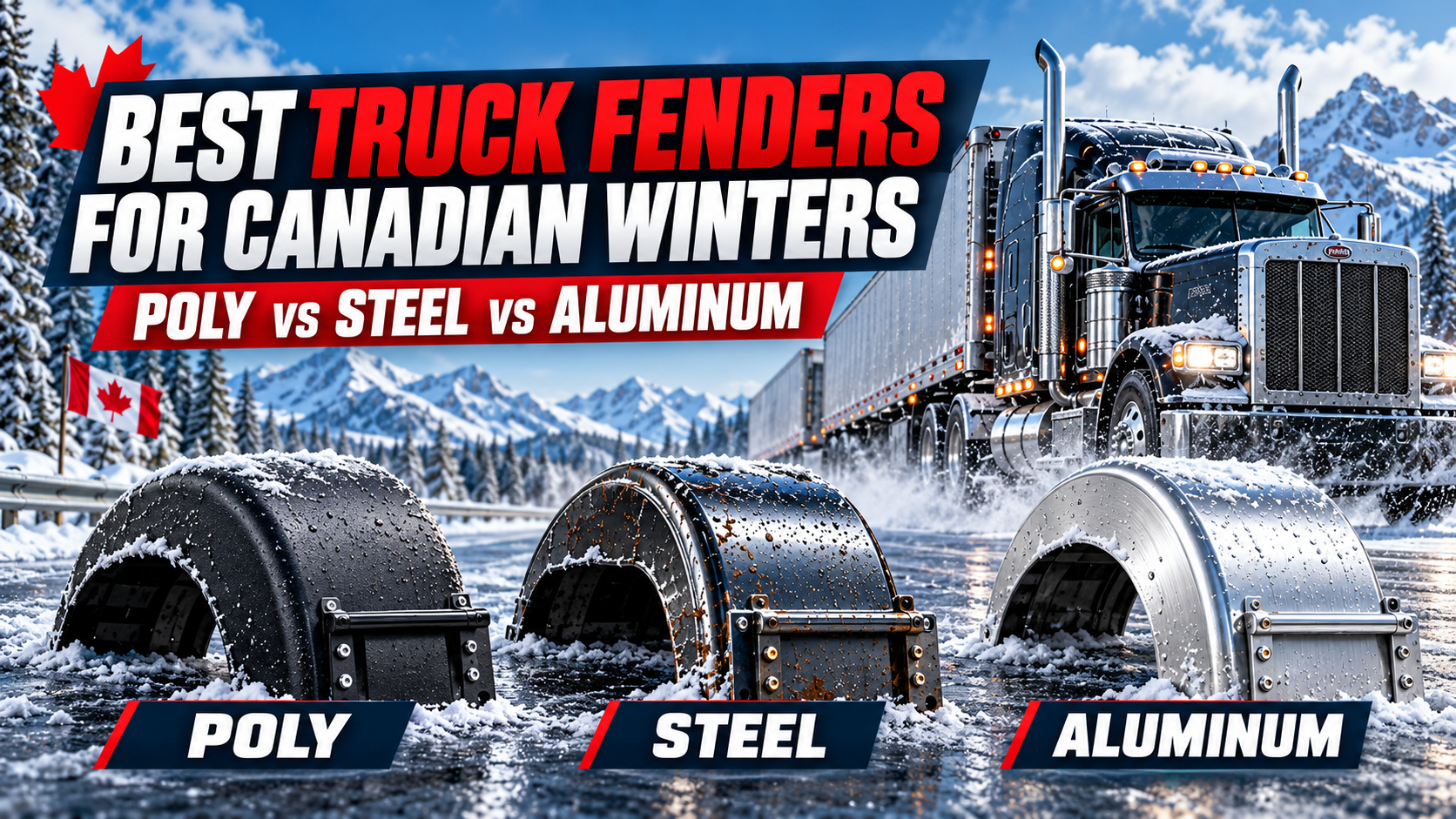
Table of Contents
| Quick Answer For Canadian winters, polyethylene (poly) truck fenders are the best choice for most commercial trucks and trailers. Poly cannot rust, stays tough instead of cracking at -40°C, sheds ice and slush easily and is the lightest option. Steel handles hard impacts but rusts quickly under road salt. Aluminum resists rust and looks sharp, but it dents, can pit from salt brine and costs more to repair. |
Key Takeaways
- Road salt and chloride brine destroy more fenders in Canada than cold alone.
- Poly fenders flex and return to shape after hits from ice chunks, snowbanks and frozen ruts.
- Steel fenders need constant paint touch-ups; once rust starts, it spreads under the coating.
- Aluminum avoids red rust but must be isolated from steel brackets to prevent galvanic corrosion.
- HEUT poly fenders are molded in Manitoba from medium density polyethylene and carry a limited lifetime warranty.
Why Are Canadian Winters So Hard on Truck Fenders?
A fender on a highway tractor running the Trans-Canada in January faces more abuse in one week than most parts see in a year. Overnight lows of -35°C give way to afternoon slush, and that freeze-thaw cycle repeats all season. Meanwhile, the tires throw a steady blast of road salt, calcium chloride brine, sand and gravel straight into the fender at highway speed.
That environment attacks a fender in three ways:
- Corrosion: chloride brine eats through paint and coatings, then the metal underneath.
- Cold impact: frozen ruts, ice chunks and plowed snowbanks hit the fender when the material is at its least forgiving.
- Weight and vibration: packed ice can add serious weight, stressing brackets and causing fatigue cracks.
The right fender material handles all three. Here is how poly, steel and aluminum compare.
Poly vs Steel vs Aluminum: Side-by-Side Comparison
| Factor | Poly (Polyethylene) | Steel | Aluminum |
| Road salt corrosion | Cannot rust or corrode | Rusts once coating chips | No red rust; can pit and oxidize |
| Performance at -40°C | Stays tough and flexible | Strong; paint chips and cracks | Strong; dents on hard impact |
| Impact recovery | Flexes back to shape | Dents and bends permanently | Dents and creases permanently |
| Weight | Lightest | Heaviest | Light |
| Ice and slush shedding | Smooth surface sheds ice easily | Ice grips rough or rusted areas | Moderate |
| Winter maintenance | Occasional rinse | Sand, prime, repaint | Polish, check for pitting |
| Road noise | Quiet, absorbs vibration | Can drum and rattle | Can rattle |
| Lifespan in the salt belt | Longest | Shortest | Medium |
Poly vs steel vs aluminum truck fenders compared for Canadian winter conditions.
Polyethylene (Poly) Truck Fenders: The Winter Workhorse
Poly fenders are molded from polyethylene, the same tough plastic family used for fuel tanks and snowplow components. Polyethylene keeps its impact strength at temperatures far colder than any Canadian highway reaches, so a frozen chunk of ice will bounce off instead of punching a hole. Because the colour runs all the way through the material, a scratch never exposes bare metal, and there is no paint to chip.
Pros
- Zero rust, zero corrosion, no matter how much salt the province spreads
- Flexes on impact and springs back to its original shape
- Lightest material, which saves weight for payload
- Smooth surface sheds snow, slush and ice buildup
- Quiet ride with less rattle from the brackets
Cons
- Can scuff with heavy abrasion, though scuffs are cosmetic only
- Needs a proper mounting kit, not improvised brackets, for best support
Why HEUT Poly Fenders Are Built for the Prairies
HEUT Ltd. is a family-owned manufacturer based at the Heartland Hutterite Colony in Cooks Creek, Manitoba, building products since 2001. Our fenders are made from medium density polyethylene in the same prairie climate they are built to survive, and every one is backed by a limited lifetime warranty. Popular models include:
- 1-030 Ext-Classic Poly Truck Fender, starting at $200
- 1-042 FGR-22.5 Fender and 1-044 FGR-24.5 Fender, sized to your tire, starting at $350
- 1-060 Steer Axle Fender and 1-050 Push Axle Fender, starting at $140
- EXT-177 Trailer Fender 1-020, starting at $180, and the TLR Trailer Fender 1-012, starting at $110
Steel Truck Fenders: Strong but Salt-Sensitive
Steel has been the traditional fender material for decades, and it still has a place. It is rigid, it handles heavy direct impacts and it makes a solid base for mounting lights and accessories. The problem is Canadian road salt. Every stone chip breaks the paint, brine gets underneath, and rust spreads out of sight until the fender flakes or a bracket lets go.
- Best for: off-road, logging and gravel operations where rigidity matters more than corrosion.
- Watch for: bubbling paint, rust at seams and weight that cuts into payload.
Aluminum Truck Fenders: Rust-Free Looks with Real Trade-Offs
Polished aluminum fenders look great on a show truck, and aluminum does not produce red rust. In winter, though, chloride brine can leave pitting and white oxidation that takes hours of polishing to remove. When aluminum touches steel brackets or bolts in salty water, galvanic corrosion can eat away at the connection. Aluminum also dents and creases permanently, and repairs or replacements are expensive.
- Best for: owner-operators who prioritize appearance and wash their truck often.
- Watch for: pitting, cracks near mounting points and corrosion where it meets steel hardware.
What Does a Truck Fender Really Cost Over Its Life?
The sticker price is only part of the bill. A steel fender that costs less up front still needs sanding, primer and paint after every salt season, plus downtime while the truck sits in the shop. When rust finally wins, you pay for the replacement fender, new hardware and labour all over again. Aluminum avoids repainting, but every dent, crack or pitted panel means a costly repair or a full replacement.
A poly fender skips those recurring costs. There is nothing to paint, nothing to rust and nothing to straighten after a winter impact. For fleet managers, multiply those savings across every axle and every unit, and the lowest lifetime cost per truck clearly belongs to poly.
| Upgrade to Canadian-made poly fenders today Stop fighting rust every spring. HEUT poly truck and trailer fenders are built in Manitoba for Canadian roads, backed by a limited lifetime warranty and shipped across Canada. Shop HEUT Truck Fenders | Call +1 204-755-2078 | Email info@heut.ca Running a fleet or a parts counter? Apply for dealer pricing or book a consultation for custom fitment. |
Which Fender Material Is Right for Your Truck?
- Choose poly if you run salted highways, manage a fleet, haul trailers or want the lowest lifetime cost with the least maintenance.
- Choose steel if your truck works mostly off-road and takes heavy direct impacts more than salt spray.
- Choose aluminum if a polished look comes first and you can commit to frequent winter washing.
For most Canadian truckers, the math points to poly: no rust repairs, no repainting and no replacement after two or three salt seasons.
Winter Fender Care Tips for Canadian Truckers
- Rinse fenders and brackets after long salt runs to stop brine from sitting on hardware.
- Knock off packed ice with a rubber mallet, never a steel bar.
- Check mounting brackets and bolts monthly, since vibration loosens hardware in the cold.
- Use a matched fender mounting kit or blind mounts for a secure, rattle-free fit.
- Do a full fender and mud flap inspection every spring before summer hauling.
Frequently Asked Questions
Do poly truck fenders crack in extreme cold?
No. Polyethylene keeps its impact strength at temperatures far colder than Canadian highways reach, so a quality poly fender flexes instead of shattering when it takes a hit from ice, a snowbank or frozen ruts at -40°C.
Are aluminum fenders better than poly for winter driving?
For most winter use, no. Aluminum avoids red rust, but it dents permanently, can pit from salt brine and reacts with steel hardware. Poly cannot rust or pit, flexes back after impacts and is lighter.
Does road salt damage plastic truck fenders?
Road salt, calcium chloride and magnesium chloride brines do not corrode polyethylene. Salt can leave a white film on the surface, which washes off with plain water.
How long do poly truck fenders last?
A well-mounted poly fender commonly outlasts several steel fenders in the salt belt. HEUT poly fenders are backed by a limited lifetime warranty.
Can I replace steel fenders with poly fenders on my truck?
In most cases, yes. HEUT supplies fender mounting kits and blind mounts for clean installs. Call 204-755-2078 with your axle and tire size to confirm fit.
Where can I buy truck fenders made in Canada?
HEUT Ltd. manufactures poly truck and trailer fenders in Cooks Creek, Manitoba, and ships across Canada. Shop online at heut.ca or contact the team for fleet and dealer pricing.
Ready to Winter-Proof Your Truck?
| Upgrade to Canadian-made poly fenders today Stop fighting rust every spring. HEUT poly truck and trailer fenders are built in Manitoba for Canadian roads, backed by a limited lifetime warranty and shipped across Canada. Shop HEUT Truck Fenders | Call +1 204-755-2078 | Email info@heut.ca Running a fleet or a parts counter? Apply for dealer pricing or book a consultation for custom fitment. |